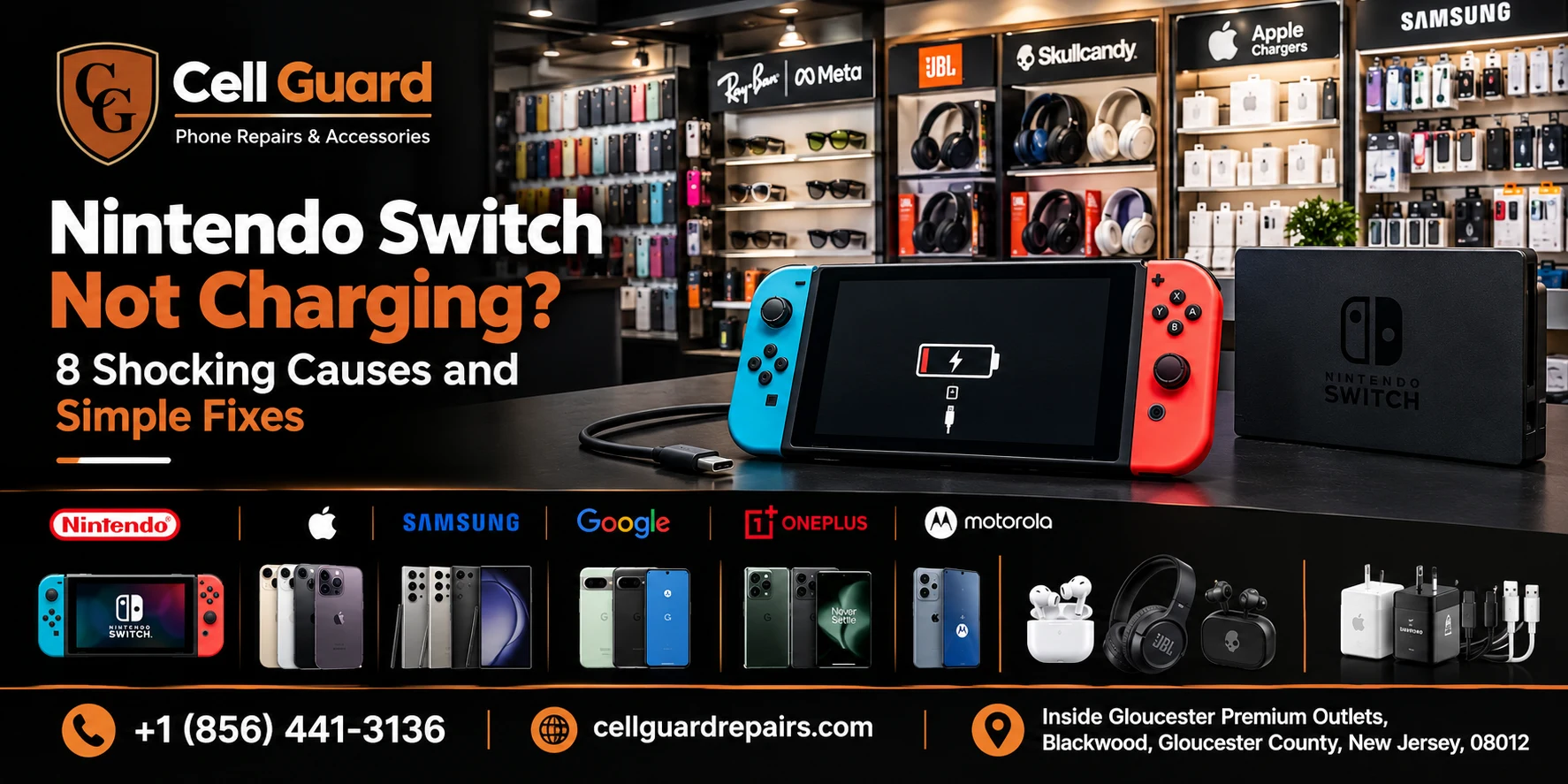
You plug it in, the little battery icon doesn’t move, and now you’re staring at a console that might be completely dead or might just be having a bad moment with the cable. Nintendo Switch not charging is one of the most common issues owners search for, and it’s genuinely one of the more frustrating ones, since there are actually several different possible causes that all look identical from the outside — a screen that won’t turn on and a charging light that isn’t doing anything.
The good news is that most of these causes are identifiable with a bit of methodical troubleshooting, and quite a few of them are things you can check or fix yourself in a few minutes. In this guide, we’re breaking down exactly why your Nintendo Switch not charging might be happening, from the simplest explanations to the ones that genuinely need a professional’s attention, so you can figure out which category your console falls into.
Why It’s Worth Troubleshooting Properly Before Assuming the Worst
A console that won’t charge understandably feels like a bigger problem than it usually turns out to be. It’s easy to jump straight to “the console is dead” when in reality, the cause is very often something external — a worn cable, an incompatible adapter, or a bit of lint in the port — rather than anything actually wrong inside the console itself.
Working through the possible causes in order, from the simplest and most common to the more involved, saves you from either giving up on a perfectly fixable console too early, or spending money on a repair for a problem that a five-dollar cable would have solved. Understanding Nintendo Switch not charging as a troubleshooting process, rather than a single mystery problem, is really the most useful mindset to have going in.
It also helps to know that this is an extremely common issue, not a sign that something unusual happened to your specific console. Between the physical stress cables endure, the wide range of third-party adapters and docks on the market, and a battery that’s doing its job for years on end, it’s genuinely one of the more predictable problems a Switch owner runs into over the life of the console — which is exactly why there’s a well-established set of steps for narrowing it down.
Let’s walk through the specific causes, starting with the most common.
1. A Faulty or Worn-Out Charging Cable
This is, by a wide margin, the most common reason behind Nintendo Switch not charging, and it’s the first thing worth ruling out before assuming anything more serious. USB-C cables take a lot of physical stress over time — bending near the connector, getting caught in bags, being yanked out at an angle — and the wires inside can fray or break well before any damage is visible from the outside.
A cable that’s starting to fail often shows inconsistent symptoms rather than failing completely: charging that works only when the cable is held at a certain angle, a connection that cuts in and out, or charging that works in one USB port but not another. These inconsistent patterns are a strong clue that the cable itself, rather than the console, is the actual problem.
What can be done: Try a different USB-C cable, ideally one you know works with another device, and see if the charging behavior changes. This single test resolves a surprisingly large number of cases of Nintendo Switch not charging, and it costs nothing but a couple of minutes if you have a spare cable lying around.
2. Using an Incompatible or Underpowered Wall Adapter
Not every USB-C wall adapter is created equal, and the Switch is more particular about this than a lot of devices. The console requires a specific power delivery profile to charge properly, especially while docked and outputting to a TV, and using a low-power or non-compliant third-party adapter can result in charging that’s extremely slow, inconsistent, or doesn’t happen at all.
This is one of the more surprising causes behind Nintendo Switch not charging, since the console will often still power on and even display a battery icon while connected to an insufficient adapter, just without the charge level actually increasing, which can make the problem look more serious than it is.
What can be done: Try the official Nintendo Switch AC adapter if you have access to one, or a reputable USB-C PD charger rated for at least 18 watts. If charging suddenly works normally with a different adapter, the original one simply wasn’t providing enough power, and replacing it solves the issue entirely.
3. A Dirty or Damaged Charging Port
Whether you’re charging through the console’s built-in USB-C port directly or through the dock, that port accumulates lint, dust, and pocket debris over time, especially if the console travels in a bag regularly. Buildup inside the port can prevent the cable from making a full, clean connection, even if it looks like it’s plugged in properly.
What can be done: With the console powered off, use a flashlight to check the port for visible lint or debris, and if you see any, a can of compressed air can often clear it out safely. Avoid using anything metal like a pin or paperclip to dig around inside the port, since this can bend the delicate internal connector pins and turn a simple cleaning into an actual repair. If the port looks clean but the connection still feels loose or wiggly, the port itself may be physically worn or damaged, which is a more involved fix.
4. Dock-Related Charging Issues
If your Switch charges fine when connected directly to a cable in handheld mode but not while sitting in the dock, the problem is likely with the dock itself rather than the console. Dock connectors can wear out from repeated docking and undocking, dust can build up inside the dock’s internal connector, or in some cases, the dock’s internal charging chip can fail independently of the console.
This is a distinction worth testing specifically, since it changes what actually needs attention. A console that charges fine outside the dock but not inside it points you toward the dock as the culprit for your Nintendo Switch not charging, rather than the console’s internal charging components.
What can be done: Try charging the console directly with a cable, bypassing the dock entirely, to confirm whether the console itself charges normally. If it does, the dock is the likely issue, and depending on its age and how it’s been treated, cleaning the internal connector or replacing the dock may be the appropriate next step.
5. A Software Glitch Preventing the Console From Recognizing Power
Occasionally, the issue isn’t hardware at all. A frozen or unresponsive system state can sometimes prevent the console from properly recognizing that it’s connected to power, even though the physical connection and cable are both fine. This is less common than the causes above, but it’s worth ruling out before assuming a hardware problem.
What can be done: Try a forced restart by holding the power button for approximately 12 seconds until the console shuts down completely, then reconnect the charger and power it back on. If the console has been completely unresponsive with no lights or display at all, leaving it connected to a known-working charger for 30 minutes to an hour before trying to power it on can also help, since a fully depleted battery sometimes needs a brief period to build up enough charge before the console will respond.
6. An Aging or Degraded Internal Battery
Like any lithium-ion battery, the one inside a Nintendo Switch degrades gradually over years of charge cycles. A console that’s a few years old and has seen regular use may start showing symptoms like a battery percentage that jumps unpredictably, a charge that seems to fill up quickly but drains just as fast, or in more advanced cases, a battery that won’t hold any charge at all despite the console otherwise appearing to charge normally.
This is one of the less obvious explanations for Nintendo Switch not charging, since the console can sometimes still display a charging icon on screen even while the underlying battery is failing to actually retain that charge, which understandably confuses a lot of owners into thinking the charger or cable is somehow the problem.
What can be done: If your console is a few years old, has seen heavy use, and other causes have been ruled out, a battery replacement is generally the most effective fix. This requires opening the console and carefully replacing the internal battery, which is a precise job given how tightly packed the internal components are.
7. Physical or Liquid Damage to Internal Charging Components
Drops, spills, or general wear over time can damage the internal components responsible for managing charging, even if the exterior of the console looks completely fine. A console that’s been exposed to any liquid, even a small splash, is particularly at risk, since moisture can cause corrosion on the charging circuitry that isn’t visible from the outside and can worsen gradually over days or weeks.
What can be done: If your Switch has been dropped recently or exposed to any liquid, and charging stopped working around the same time, it’s worth having it inspected rather than continuing to try different cables and adapters. Continuing to attempt charging a console with underlying liquid damage can sometimes make the problem worse, so it’s better addressed sooner rather than later.
8. A Failing Charging IC on the Motherboard
The charging IC, sometimes called the charging chip, is the small component responsible for managing how power flows from the cable or dock into the console’s battery. When this specific component fails, a Switch can display symptoms that look almost identical to a bad cable or adapter — no charging indication at all, or extremely inconsistent charging — even though every external cause has already been ruled out.
This is one of the more involved explanations behind Nintendo Switch not charging, and it’s usually the conclusion reached only after simpler causes like cables, adapters, and ports have already been tested and eliminated. A failing charging IC genuinely requires a technician to diagnose properly, since it involves testing the console’s internal circuitry directly rather than anything visible from the outside.
What can be done: If you’ve worked through cables, adapters, the port, and the dock, and the console still won’t charge, it’s a strong sign the issue is on the motherboard itself. This is a repair that requires specialized tools and soldering experience, and it’s not something to attempt without the right equipment, given how easy it is to cause additional damage to a densely packed circuit board.
A Simple Troubleshooting Order to Follow
If you’re not sure where to start, working through these steps in order tends to be the most efficient way to narrow down Nintendo Switch not charging without unnecessary guesswork: try a different cable, try a different (properly rated) wall adapter, inspect and clean the charging port, test charging directly versus through the dock, attempt a forced restart, and note whether the console is a few years old with heavy use, which raises the likelihood of a battery issue. If none of these resolve it, you’re most likely looking at a hardware problem that needs a proper diagnostic, whether that’s the battery, internal charging components, or the charging IC itself.
Signs It’s Time to Stop Troubleshooting and See a Professional
Working through cables, adapters, and the port yourself is a completely reasonable first step, but a few signs suggest it’s time to stop guessing and get an actual diagnostic. If you’ve tried multiple known-working cables and adapters with no change at all, if the console shows any physical signs of damage like a swollen back panel or a bent port, or if charging worked fine until a specific drop or spill and stopped immediately afterward, continuing to experiment on your own is unlikely to help and could potentially make things worse.
Similarly, if your console is several years old, has seen heavy daily use, and every external cause has already been ruled out, the odds shift meaningfully toward an internal battery or component issue rather than something you can resolve with a new cable. At that point, the most efficient path to actually solving Nintendo Switch not charging is a proper diagnostic from someone who can test the internal circuitry directly, rather than continuing to swap accessories and hope one of them makes a difference.
How Much Does It Typically Cost to Fix a Charging Issue?
Costs vary quite a bit depending on the actual cause. If the problem turns out to be a bad cable or adapter, the fix costs whatever a quality replacement runs, often less than the cost of a single game. A dock issue, depending on whether it just needs cleaning or an outright replacement, tends to fall in a similarly moderate range.
Internal repairs — a battery replacement, charging port repair, or a failing charging IC — involve more parts and labor, and pricing depends on which specific component is affected. Rather than guessing, it’s worth getting an actual quote based on your specific situation. Most reputable repair shops, including Cell Guard Repairs, can run a proper diagnostic and give you a clear estimate, so you know exactly what you’re dealing with before committing to anything.
DIY Fixes vs. Professional Repair: Where to Draw the Line
Everything covered in the troubleshooting order above — trying a different cable, testing a different adapter, cleaning the exterior of the port, and attempting a forced restart — is genuinely safe to try yourself with no risk to the console. These steps resolve a large share of Nintendo Switch not charging cases without ever needing to open the device.
Where it becomes a different situation is once you’ve ruled those out and you’re left with a genuine hardware issue — a worn battery, internal charging port damage, or a failing charging IC. Opening a Nintendo Switch involves specialized tools, careful handling of ribbon cables and small screws, and in the case of a charging IC repair, actual soldering work on the motherboard. This isn’t a repair to attempt without the right experience, since a small mistake can turn a repairable console into one that’s genuinely beyond fixing.
If you’re in the Blackwood, New Jersey area, the team at Cell Guard Repairs handles Nintendo Switch charging repairs regularly, from straightforward port cleanings to battery replacements and board-level diagnostics. You can take a look at the full range of gaming console repair services offered, or read a bit more about the people behind the shop before deciding where to bring your console in.
What Happens When You Bring In Your Console
Walking in with a console that just won’t charge doesn’t require you to already know which of the causes above is responsible — that’s exactly what a proper diagnostic is for. A good technician should be able to systematically test cables, adapters, the port, the dock, and the internal battery to pinpoint exactly what’s going on before recommending any specific repair.
At Cell Guard Repairs, common issues like port cleaning and battery replacement can often be handled same-day, while more involved board-level repairs may take a bit longer depending on parts availability. If you’d rather skip the guesswork and get things moving right away, you can start your repair request online and describe what your console is doing. Someone from the team will follow up with next steps, a cost estimate, and a realistic timeline for getting it back in working order.
Common Misconceptions About Switch Charging Problems
A few assumptions tend to circulate about this issue that are worth clearing up.
“If the console won’t turn on at all, the battery is definitely dead for good.” A completely unresponsive console is often just a fully depleted battery that needs time connected to a known-working charger before it responds, rather than a battery that’s failed permanently. It’s worth trying this before assuming the worst.
“Any USB-C charger should work fine.” As covered earlier, the Switch has specific power requirements, especially in docked mode, and a generic or underpowered charger can result in charging that appears to happen but doesn’t actually add to the battery level.
“A charging problem always means the console needs to be replaced.” In the vast majority of cases, Nintendo Switch not charging traces back to an external cause like a cable, adapter, or dirty port, all of which are inexpensive, straightforward fixes that don’t involve the console’s internals at all.
“If it charges a little, the charging system is fine.” Inconsistent or partial charging is still a meaningful symptom, not a sign that everything is working correctly. It often points to a failing component that’s still partially functional now but likely to fail completely later.
Simple Habits That Help Prevent Charging Issues
A few ongoing habits can meaningfully reduce how often you run into charging problems in the first place. Handle the charging cable gently, particularly near the connector ends, and avoid letting it get bent at sharp angles or crushed under other items in a bag. Use a quality cable and a properly rated adapter rather than the cheapest option available, since underpowered or poorly made accessories are a common, avoidable source of charging issues.
Periodically check the charging port for lint or debris, especially if the console travels frequently, and clean it gently with compressed air rather than waiting until charging becomes unreliable. If you use the dock regularly, be mindful when docking and undocking the console, since repeated rough handling is one of the more common ways dock connectors wear out prematurely. None of these habits guarantee you’ll never run into Nintendo Switch not charging again, but they meaningfully reduce the odds and often extend the life of the components involved.
Frequently Asked Questions
Is it normal for a Nintendo Switch to charge slowly in handheld mode while playing? Yes, to some extent. Playing demanding games while charging draws power at the same time the battery is trying to charge, which can result in a slower net charging rate, or in some cases, a battery percentage that stays roughly flat rather than climbing quickly.
Can using third-party Joy-Con or accessories cause charging issues with the console itself? Generally no — Joy-Con charging and console charging are largely separate systems, so a problem with a Joy-Con typically won’t affect whether the main console charges normally, though it’s worth ruling out as a coincidence if both started around the same time.
Will a factory reset fix a charging problem? A factory reset can help with certain software-related glitches, but it won’t resolve a hardware issue like a worn cable, damaged port, or failing battery. It’s worth trying simpler troubleshooting steps first before resorting to a reset, which also erases your data if not backed up properly.
How long should a Nintendo Switch battery typically last before needing replacement? Most Switch batteries hold up reasonably well for two to four years of regular use before owners start noticing a meaningful decline, though this varies based on how often the console is used and how it’s typically charged.
Is it safe to leave my Nintendo Switch charging overnight regularly? Modern consoles, including the Switch, are designed to stop drawing significant power once the battery reaches full charge, so occasional overnight charging isn’t a major concern. That said, using a quality charger and avoiding leaving it charging in direct sunlight or a hot environment is still a good habit for long-term battery health.
Can extreme temperatures affect whether my Switch charges properly? Yes. Charging in a very cold or very hot environment can cause a console to charge more slowly, or in some cases, temporarily refuse to charge at all as a built-in safety measure. Letting the console return to a normal room temperature usually resolves this without any further action needed.
My Switch shows the charging icon but the battery percentage isn’t going up. What does that mean? This usually points to an underpowered adapter, a partially faulty cable, or a struggling battery that can accept a small trickle of charge but not enough to meaningfully increase the percentage. It’s a good example of a symptom worth testing against the troubleshooting order outlined earlier rather than assuming any single cause right away.
Visit Cell Guard Repairs in Person
Sometimes it’s easier to just bring the console in and let someone experienced run a proper diagnostic rather than working through every possible cause on your own. Cell Guard Repairs is located next to UGG’s, 100 Premium Outlets Dr Store #785, Gloucester Premium Outlets, Blackwood, NJ 08012, United States, making it an easy stop if you’re already running errands or grabbing a bite nearby.
Stopping by in person means you can describe exactly what your console is doing, have it tested right there with proper equipment, and in many cases, walk out the same day with it charging normally again. If you’d rather sort out the details first, the team is happy to help over the phone or by email:
✉️ Email Us: aroracases@gmail.com
Or, if you’d like to start things digitally, you can always submit a repair request online and skip straight to getting a plan in place.
Final Thoughts
A console that won’t charge is stressful in the moment, but in the vast majority of cases, Nintendo Switch not charging comes down to one specific, identifiable cause rather than a console that’s simply beyond saving. Working through the possibilities in order — starting with the cable, the adapter, and the port before considering anything internal — gives you the clearest, fastest path to an actual answer.
If you’ve worked through the troubleshooting steps in this guide and your console still won’t charge, it’s worth getting it looked at by someone who can test it properly rather than continuing to guess. Reach out through the contact page, give the shop a call, or stop by Cell Guard Repairs at the Gloucester Premium Outlets and let someone who works on these consoles every day take a proper look. You can also browse more device tips and guides on the blog while you’re at it. And if you’re curious what other customers have experienced, feel free to take a look at our reviews on Google.
 by
by