
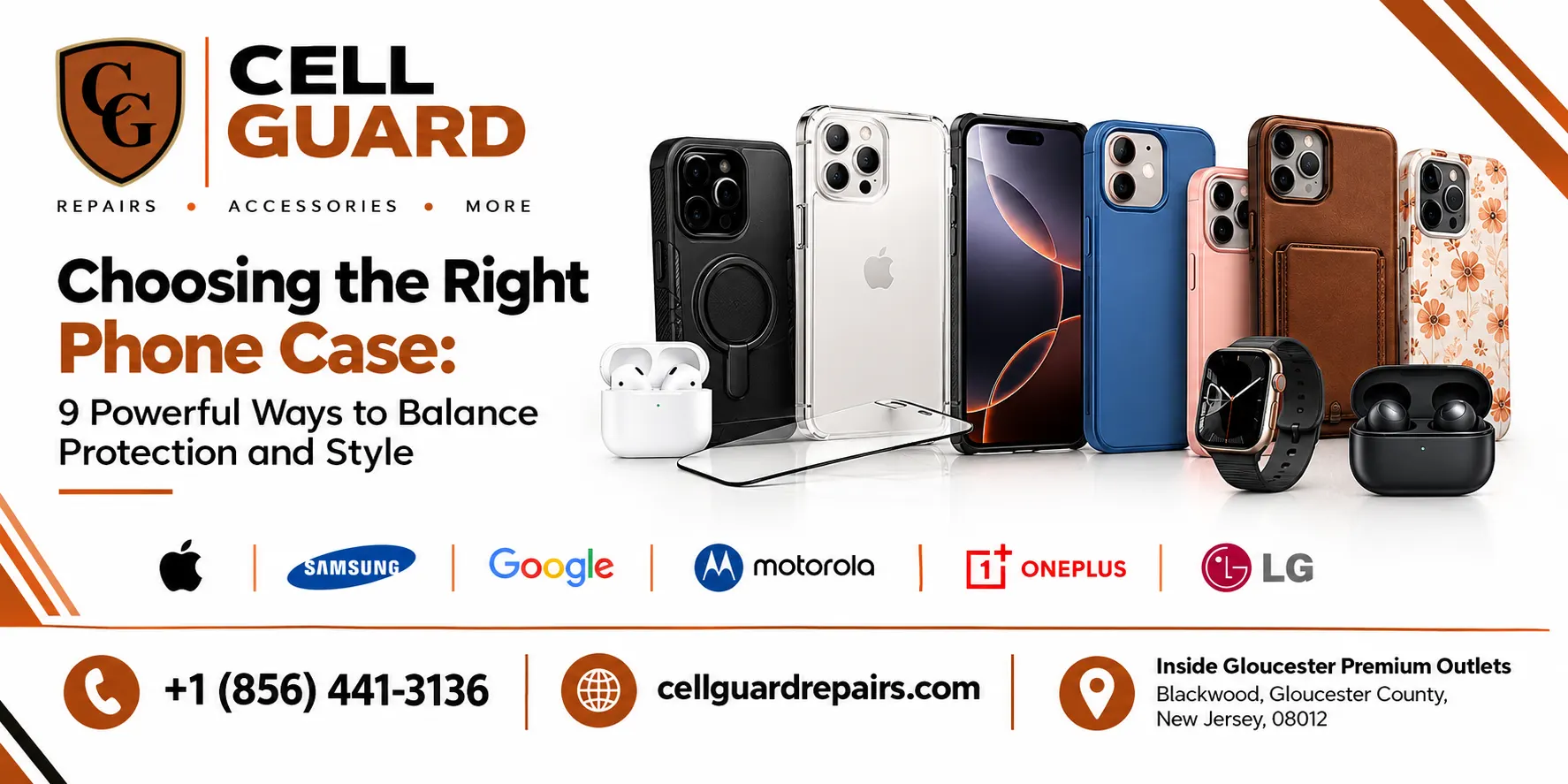
Your phone goes almost everywhere with you. It sits on your desk, rides in your car, travels in your pocket, gets carried through work and school, and sometimes ends up on tables, countertops, or even the floor. That makes choosing the right phone case more important than it may initially seem.
When choosing the right phone case, most people are trying to balance two things: protection and style. A rugged case may provide excellent drop protection but feel bulky, while a slim and attractive case may look great but provide less defense against serious impacts. The right choice depends on how you use your phone, where you take it, and the type of protection you actually need.
With so many materials, designs, thicknesses, brands, and features available, choosing the right phone case can quickly become confusing. Should you choose a rugged case? Is a clear case enough? Does a wallet case make sense? What about MagSafe compatibility, raised edges, camera protection, or screen coverage?
This guide breaks down the most important factors so you can make a practical decision without sacrificing your personal style.
Why Choosing the Right Phone Case Matters
A smartphone is a significant investment. Modern phones can include expensive displays, glass backs, sophisticated camera systems, wireless charging components, and other delicate internal hardware.
A case cannot make a phone indestructible, but it can help reduce the consequences of everyday accidents.
Consider what happens during a typical day. Your phone might slip from your hand while you’re getting out of your car. It could slide off a table, fall from a desk, or drop onto a hard floor. Even a relatively short fall can cause cracked glass, scratched corners, damaged camera lenses, or other problems.
This is where choosing the right phone case becomes a practical decision rather than simply a fashion choice.
The goal isn’t necessarily to purchase the thickest case available. Instead, you want to find a case that matches your lifestyle.
Someone who works in an office and keeps their phone on a desk most of the day may have very different requirements from someone who works outdoors, travels frequently, plays sports, or regularly carries their phone around construction or industrial environments.
The best case is the one that provides an appropriate level of protection without making your phone uncomfortable or inconvenient to use.
1. Start by Understanding Your Lifestyle
The first step in choosing the right phone case is thinking about how you actually use your phone.
Don’t start with colors or patterns. Start with your daily routine.
Ask yourself:
- Do you frequently drop your phone?
- Do you work outdoors?
- Do you spend a lot of time traveling?
- Do you keep your phone in your pocket?
- Do you carry it in a purse or backpack?
- Do you use wireless charging?
- Do you frequently take photos?
- Do you work around dust, tools, or hard surfaces?
- Do you use your phone while exercising?
- Do you prioritize a thin and lightweight design?
Your answers can point you toward the right type of case.
If you’re careful with your phone
If you rarely drop your phone and mainly want protection against scratches and minor bumps, a slim case may be sufficient.
A lightweight silicone, TPU, hybrid, or clear case can provide basic protection without substantially changing the size or appearance of your phone.
If you’re frequently dropping your phone
If your phone has already hit the floor several times, you may want to prioritize impact protection.
Look for reinforced corners, shock-absorbing materials, raised bezels, and a secure grip.
If you work outdoors
Outdoor environments introduce additional risks. Dust, moisture, drops, rough surfaces, and accidental impacts can all become concerns.
A more protective case with reinforced construction may make sense in this situation.
This is one of the biggest reasons choosing the right phone case should be based on your lifestyle rather than simply picking the case that looks best online.
2. Understand the Difference Between Slim and Rugged Cases
One of the most common decisions people face when choosing the right phone case is deciding between a slim case and a rugged case.
Both have advantages.
Slim phone cases
Slim cases are designed to maintain as much of the original phone’s feel as possible.
Their advantages often include:
- Lightweight construction
- Easier pocket storage
- Better access to buttons and ports
- Minimal change to the phone’s original appearance
- Less bulk
- Easier wireless charging compatibility
The downside is that a very thin case generally cannot provide the same level of impact protection as a heavily reinforced rugged case.
Slim cases are therefore often a good option for people who primarily want scratch, scuff, and minor-impact protection.
Rugged phone cases
Rugged cases generally use multiple layers, reinforced corners, thicker edges, or other protective features.
They can be particularly useful for people who:
- Work outdoors
- Frequently drop their phones
- Travel often
- Participate in physical activities
- Keep their phones around children
- Work around tools or hard surfaces
The tradeoff is additional size and weight.
A rugged case may also make it more difficult to fit your phone into tight pockets or smaller bags.
Neither style is automatically right for everyone. Choosing the right phone case means deciding how much protection you actually need.
3. Look at the Case Material
The material used in a phone case can influence grip, flexibility, durability, appearance, and protection.
Several materials are commonly used.
TPU
Thermoplastic polyurethane, commonly called TPU, is popular because it can be flexible while still offering useful impact protection.
TPU cases are often relatively lightweight and can provide a comfortable grip.
They are available in everything from transparent designs to colorful patterns.
Silicone
Silicone cases are generally soft and comfortable to hold.
They can provide a pleasant grip and are often available in a wide variety of colors.
However, silicone can sometimes attract lint or dust, depending on the finish.
Polycarbonate
Polycarbonate is a harder plastic that can add structural rigidity to a case.
It is commonly used in protective and hybrid designs.
Polycarbonate can also work well for cases featuring printed graphics, clear panels, or decorative designs.
Leather and synthetic leather
Leather-style cases appeal to people who want a more sophisticated appearance.
They can look professional and may develop a distinctive appearance with use.
Synthetic leather can offer a similar visual style at a different price point.
Hybrid materials
Some cases combine multiple materials to balance flexibility, rigidity, grip, and impact resistance.
For example, a case may use a rigid back with flexible edges.
When choosing the right phone case, don’t judge a case only by how it looks. Consider how its materials will feel in your hand and how they match your daily routine.
4. Don’t Ignore the Corners and Edges
A case can look protective while still leaving important areas vulnerable.
Corners deserve particular attention because they can experience significant impact during a drop.
When choosing the right phone case, look for designs with reinforced corners or additional shock-absorbing material around those areas.
The edges are also important.
A useful case design typically provides some protection around the phone’s frame while leaving buttons and ports accessible.
Raised edges around the screen can also help prevent the display from making direct contact with a flat surface when the phone is placed face down.
However, raised edges are not a guarantee against screen damage. A phone can still be damaged if it lands directly on an object, hits a corner, or experiences enough force during a fall.
That’s why a case should be viewed as one part of your phone-protection strategy rather than a guarantee that damage cannot happen.
5. Pay Attention to Camera Protection
Modern smartphones increasingly rely on sophisticated camera systems.
The camera modules on many phones extend from the back of the device, which means they can be exposed when the phone is placed on a table.
When choosing the right phone case, look for a case that provides a raised lip or protective area around the camera module.
This can reduce direct contact between the camera area and surfaces.
Camera protection is especially important for people who frequently place their phones on desks, counters, tables, or other hard surfaces.
At the same time, make sure the case does not interfere with the camera lenses or flash.
A poorly designed case can create unwanted reflections, interfere with accessories, or partially obstruct the camera.
A well-designed case should protect the camera while allowing you to use the entire camera system normally.
6. Think About Screen Protection Too
A phone case protects the body of your device, but the display remains one of its most important vulnerable components.
This is why choosing the right phone case should also involve thinking about how the case works with screen protection.
Many people pair their case with a tempered-glass screen protector or another compatible protective film.
A raised case edge combined with a properly installed screen protector can provide an additional layer of defense against everyday scratches and impacts.
However, compatibility matters.
Some cases have very tight edges and may interfere with certain screen protectors. Others may cause a protector to lift around the corners.
Before purchasing both products, check that they are designed to work together.
If your screen protector constantly lifts or develops bubbles around the edges after installing a particular case, the two products may not be a good match.
7. Don’t Forget Wireless Charging and Magnetic Accessories
Wireless charging has become a standard feature on many modern smartphones.
If you use wireless charging regularly, choosing the right phone case means checking whether the case supports your charging setup.
Some thick or poorly designed cases can interfere with charging performance.
Magnetic accessories also deserve attention.
If your phone uses a magnetic accessory system, make sure the case is compatible with it.
This can be particularly important if you use:
- Magnetic car mounts
- Wireless charging stands
- Magnetic wallets
- Desk charging accessories
- Magnetic battery packs
A case may look perfect but become frustrating if you have to remove it every time you want to use an accessory.
Before purchasing, think about your complete setup rather than just the case itself.
Your phone case, charger, screen protector, car mount, and other accessories should ideally work together.
8. Style Matters — and That’s Completely Fine
Protection is important, but there is nothing wrong with wanting your phone to look good.
For many people, the phone is something they carry every day, so appearance naturally matters.
Fortunately, choosing the right phone case doesn’t mean you have to choose between protection and style.
There are protective cases available in countless designs.
You can find:
- Transparent cases
- Minimalist cases
- Colorful cases
- Patterned cases
- Textured cases
- Leather-style cases
- Graphic cases
- Matte finishes
- Glossy finishes
- Personalized designs
If you love the original color of your phone, a clear case can provide protection while allowing the device’s design to remain visible.
If you prefer something more distinctive, a patterned or colorful case can turn the case into an accessory.
The important thing is to make sure style doesn’t completely override function.
A beautiful case that provides almost no protection may not be the best choice if you’re frequently dropping your phone.
Likewise, a massive rugged case may be unnecessary if you primarily use your phone in controlled environments.
The sweet spot is a case that fits both your personality and your lifestyle.
9. Consider Grip and Everyday Comfort
One factor that is easy to overlook when choosing the right phone case is how the case feels in your hand.
Modern smartphones can be large and smooth. Glass backs and thin frames can sometimes make them difficult to grip.
A case with a textured or slightly rubberized surface can make the phone easier to hold.
This can indirectly reduce the likelihood of accidental drops.
Think about how you normally hold your phone.
Do you use it one-handed?
Do you frequently type while walking?
Do you take photographs with one hand?
Do you use your phone while getting in and out of your car?
These everyday situations can make grip especially important.
A case that feels secure in your hand may be more useful than one that simply looks attractive.
Protection vs. Style: Which Should Come First?
The protection-versus-style debate doesn’t really have a universal answer.
Instead, think about your personal priorities.
If you frequently drop your phone, protection may deserve greater attention.
If your phone rarely leaves your desk and you primarily want scratch protection, a slimmer design may make more sense.
If you’re highly concerned about appearance, look for protective cases that match your style.
If you use multiple accessories, prioritize compatibility.
The key to choosing the right phone case is recognizing that there isn’t one perfect case for every person.
The right case for a construction worker may be excessive for an office employee.
The right case for a frequent traveler may be different from the right case for a student.
The right case for a parent carrying a phone around young children may be different from the right case for someone who almost never drops their device.
Your lifestyle should determine the level of protection.
Common Phone Case Mistakes to Avoid
Even after researching cases, people sometimes make choices that reduce the benefits of their purchase.
Here are several common mistakes to avoid.
Choosing a case solely because it looks good
A stylish case may not provide enough protection for your needs.
Always check the construction, corners, edges, camera protection, and material.
Buying the thickest case available
More protection isn’t always better if the case becomes so bulky that you stop enjoying your phone.
If a case is uncomfortable, difficult to carry, or constantly gets removed, its protective benefits become less useful.
Ignoring compatibility
A case should work with your charger, screen protector, camera system, buttons, and other accessories.
Buying a case for the wrong phone model
This sounds obvious, but phone models can have similar dimensions while having different camera layouts, buttons, or port arrangements.
Always verify the exact model before purchasing.
Forgetting about the screen
A protective case is not a replacement for sensible screen protection.
If you’re concerned about display damage, consider the case and screen protector as complementary products.
Not replacing a damaged case
Cases can wear out.
If the case has cracked corners, stretched edges, broken sections, or significant damage, it may no longer provide the protection it originally offered.
How Often Should You Replace a Phone Case?
There is no universal replacement schedule.
Instead, inspect the condition of the case.
You may want to consider replacing it when:
- The corners are cracked
- The edges are loose
- The case no longer fits securely
- The material has become brittle
- The protective lip is damaged
- The case has suffered a major impact
- The buttons no longer work properly through the case
- The case interferes with charging
- The back has become significantly worn
If your phone case has taken a serious fall and shows visible damage, replacing the case may be sensible even if the phone itself appears fine.
The case may have absorbed part of the impact.
What If Your Phone Is Already Damaged?
Even with careful choosing the right phone case, accidents can happen.
Phones can still experience cracked screens, damaged charging ports, broken back glass, battery problems, camera issues, and other hardware problems.
A case can reduce certain risks, but it cannot prevent every type of failure.
If your phone has already been damaged, the next step is to determine whether it needs professional repair.
For example, a cracked screen may affect touch sensitivity or visibility. A damaged charging port may cause intermittent charging. A worn battery may cause unexpectedly short battery life.
In those situations, continuing to use the device without addressing the underlying problem can become frustrating.
If you are in the Blackwood area or visiting Gloucester Premium Outlets, Cell Guard’s services page provides information about available device repair services.
Cell Guard focuses on practical device problems that people encounter every day, including phone, tablet, laptop, and gaming console repairs.
The goal isn’t simply to sell another accessory. Sometimes the most useful solution is helping someone understand what’s actually wrong with a device and what options they have.
Phone Cases Are Part of a Bigger Protection Strategy
A case is important, but protecting your phone involves more than just putting it inside a protective shell.
Consider combining several simple habits.
Keep your phone away from extreme environments
Excessive heat, moisture, dust, and other environmental factors can create problems.
Avoid placing your phone near the edge of surfaces
Many accidental drops happen because a phone gets knocked off a desk, counter, or table.
Don’t carry your phone with hard objects
Keys and other objects can scratch the phone or case.
Keep charging accessories in good condition
Damaged cables and connectors can create charging problems.
Clean your phone and case occasionally
Dust and debris can collect between a case and the phone.
Removing the case periodically and cleaning both surfaces can help prevent grit from rubbing against the device.
Inspect the phone after a major drop
Even if there is no visible damage, check the screen, cameras, buttons, charging, speakers, and other functions.
A serious impact can sometimes create problems that aren’t immediately obvious.
A Simple Checklist for Choosing Your Next Phone Case
If you’re standing in a store or browsing cases online, use this checklist.
1. Confirm your exact phone model
Don’t rely solely on appearance.
2. Decide how much protection you need
Think about your daily environment and how often you drop your phone.
3. Choose your preferred case thickness
Decide whether you want slim, medium, or rugged protection.
4. Check the corners
Look for reinforced or shock-absorbing construction if you need additional protection.
5. Check the screen edge
A raised bezel can provide additional separation between the display and flat surfaces.
6. Check camera protection
Make sure the camera module has adequate clearance and protection.
7. Consider grip
Choose a finish that feels secure in your hand.
8. Check accessory compatibility
Make sure the case works with your wireless charger, magnetic accessories, car mount, and other equipment.
9. Choose a style you’ll actually enjoy
Protection doesn’t have to mean giving up personality.
10. Inspect the case periodically
Replace it when it becomes damaged or stops fitting properly.
Following these steps can make choosing the right phone case much easier.
Is an Expensive Phone Case Always Better?
Not necessarily.
Price can reflect materials, construction, brand, design, and additional features, but a higher price does not automatically mean a case is the right choice for you.
A moderately priced case that fits your phone properly, provides appropriate protection, feels comfortable, and works with your accessories can be more practical than an expensive case with features you don’t need.
Instead of focusing entirely on price, focus on value.
Ask:
- Does it provide enough protection?
- Does it fit correctly?
- Is it comfortable?
- Does it work with my accessories?
- Do I like the design?
- Is the material appropriate for my lifestyle?
This approach makes choosing the right phone case less about finding the most expensive product and more about finding the most suitable one.
Clear Cases vs. Colored Cases
Clear cases remain popular because they allow the original design of the phone to remain visible.
They’re particularly appealing when someone has purchased a phone in a color they really like.
However, clear materials can change appearance over time depending on the material, use, and environmental exposure.
Colored cases offer another advantage: they can provide a completely different look without changing the phone itself.
For people who like to change their style regularly, cases can be an inexpensive way to refresh the appearance of a familiar device.
You can have one case for work, another for travel, and another for a special occasion.
That flexibility is one of the reasons phone cases have become both protective accessories and fashion accessories.
Wallet Cases: Convenience vs. Bulk
Wallet cases can be useful for people who want to carry fewer items.
Some designs provide space for cards or identification, combining phone protection with basic wallet functionality.
The tradeoff is additional thickness.
If you already carry a separate wallet or rarely need to carry cards, a wallet case may add unnecessary bulk.
When choosing the right phone case, consider whether you actually need the features you’re paying for.
Extra functionality is useful when it solves a real problem.
It isn’t necessarily useful simply because it is available.
Transparent, Minimalist, or Rugged: Which Style Fits You?
A simple way to think about case selection is to divide users into three broad groups.
The minimalist
You want your phone to feel as close to its original design as possible.
A slim or clear case may suit you.
The balanced user
You want meaningful protection without a huge increase in size.
A hybrid case can provide a middle ground.
The protection-focused user
You frequently work or travel in environments where drops and impacts are more likely.
A rugged case may be more appropriate.
Of course, many people fall somewhere between these categories.
That’s why choosing the right phone case should be personalized rather than based on a one-size-fits-all recommendation.
Your Phone Case Should Make Your Life Easier
Ultimately, a good phone case should disappear into your routine.
You shouldn’t have to constantly think about whether it is compatible with your charger.
You shouldn’t struggle to press the buttons.
You shouldn’t find it uncomfortable to carry.
And you shouldn’t have to give up the appearance you like simply to get reasonable protection.
The best case is one that quietly performs its job while fitting naturally into your lifestyle.
That’s the real goal of choosing the right phone case.
Protection matters. Style matters. Comfort matters. Compatibility matters.
Finding the right balance is what matters most.
What to Do If Your Phone Has Already Taken a Hit
Sometimes the case does its job and absorbs an impact. Other times, the phone still suffers damage.
If you’ve dropped your device and notice a cracked display, touch problems, charging issues, camera problems, battery concerns, damaged buttons, or other unusual behavior, it’s worth having the device assessed.
For local customers, Cell Guard is located inside Gloucester Premium Outlets in Blackwood, New Jersey, and provides repair services for a variety of everyday devices.
You can learn more about the business through the Cell Guard homepage, or use the repair form if you want to provide information about your device before visiting.
The store is located at:
Next to UGG’s, 100 Premium Outlets Dr Store #785, Gloucester Premium Outlets, Blackwood, NJ 08012, United States
Get directions to Cell Guard on Google Maps
For inquiries, you can Call Now at +1 856 441 3136 or Email aroracases@gmail.com.
You can also visit the Cell Guard Google Business Profile to learn more and see customer feedback.
Final Thoughts
Choosing the right phone case doesn’t have to be complicated.
Start with your lifestyle. Think about how often you drop your phone, where you use it, how much bulk you can tolerate, and which accessories you rely on.
Then consider the case’s materials, corners, raised edges, camera protection, grip, charging compatibility, and overall design.
Most importantly, don’t assume that the thickest or most expensive case is automatically the best option.
Your ideal case should provide an appropriate level of protection while remaining comfortable, functional, and visually appealing.
A phone case is a relatively simple accessory, but the right one can make everyday phone ownership easier and provide an extra layer of protection against the accidents that happen in real life.
And if an accident has already happened, don’t assume the problem is beyond repair. Whether it’s a damaged screen, charging issue, battery problem, or another hardware concern, getting the device properly assessed can help you understand your options before deciding what to do next.
The right case protects your phone. The right habits protect it further. And when something does go wrong, having a reliable local repair option can make the situation much less stressful.
 by
by